
What Makes a High-Quality Backlink? 10 Things SEO Professionals Check
High-quality backlinks come from relevant, trusted websites. They sit inside helpful content. And they’re added because they help readers, not because money changed hands. One link like that can be worth more than a hundred weak ones.
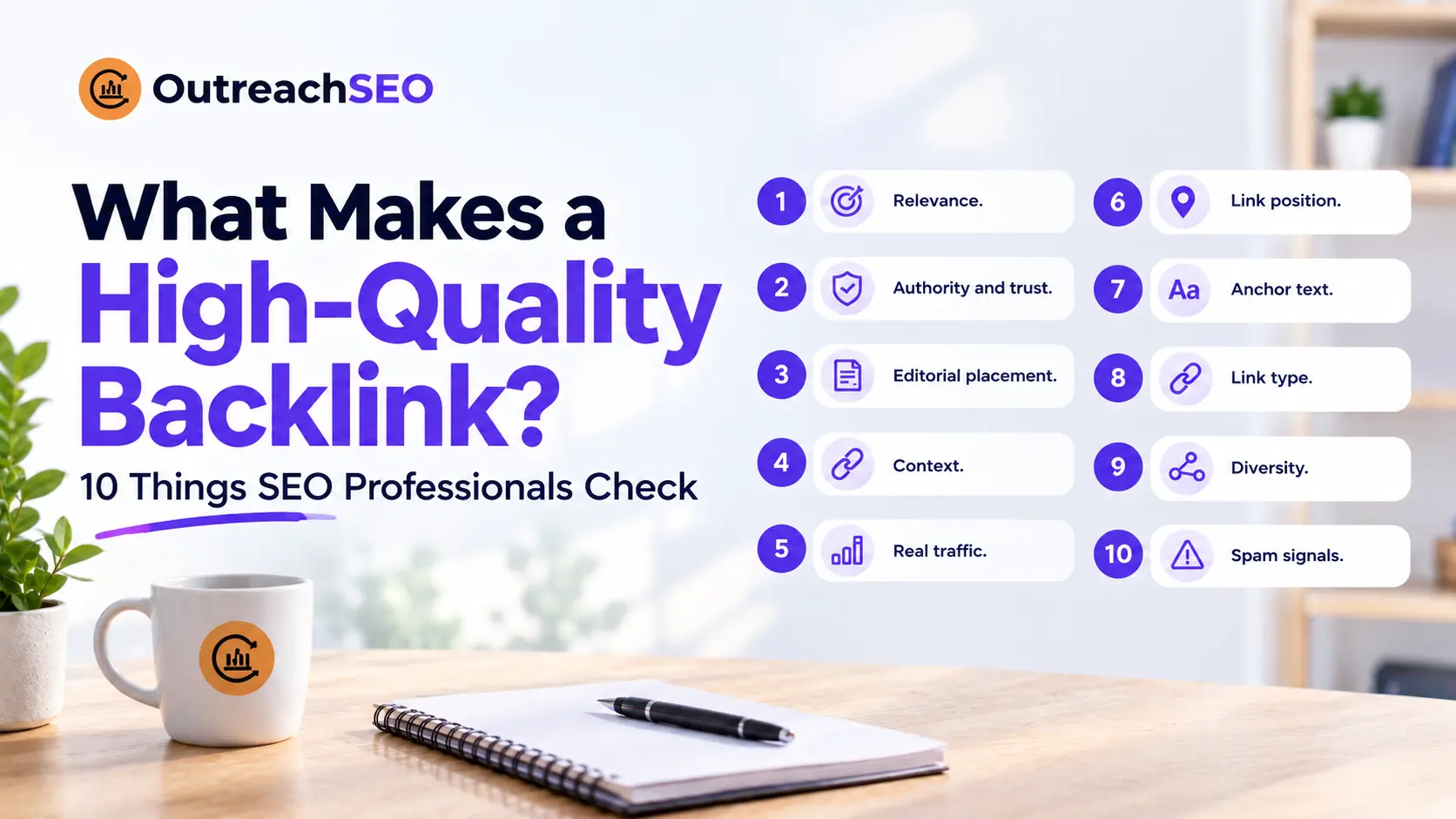
Here’s the whole answer in one place. SEO pros check these 10 things:
- Relevance. Does the site cover your topic?
- Authority and trust. Is it a real, respected site?
- Editorial placement. Did someone choose to add the link?
- Context. Does the text around the link make sense?
- Real traffic. Do real people read the page?
- Link position. Is it inside the main content?
- Anchor text. Does it look natural?
- Link type. Is it honestly tagged as dofollow, nofollow, or sponsored?
- Diversity. Do your links come from many different sites?
- Spam signals. Are there any red flags?
A link that passes most of these is worth having. A link that fails several is not. Tool scores like Domain Authority are only a rough guide, because Google doesn’t use them. And never pay for a link that isn’t labeled as paid.
Why does this matter? An analysis of 11.8 million Google results found the #1 result has about 3.8 times more backlinks than positions #2 through #10. That’s a correlation, not proof. But the same study found about 95% of pages have zero backlinks, so good links help you stand out.
Let’s go through the checklist.
What Are High-Quality Backlinks?
High-quality backlinks are links from trusted, relevant sites that point to your page for a good reason. They’re earned, not forced.
Think of a job reference. A strong note from a respected person in your field carries weight. A note from a stranger who has never seen your work? Not so much.
Google reads links in a similar way. A link works like a vote, and the voter matters.
Google doesn’t publish a link-scoring checklist. This list comes from what Google has said in public, large industry studies, and what pros see in practice.
1. Relevance
This is the first thing most pros look at. Does the linking site cover a topic close to yours?
A plumbing company with a link from a home repair blog? Great. The same company with a link from a casino review site? Odd. Search engines notice.
Relevant backlinks tell Google your page belongs in that topic. Link relevance also matters at the page level. A link from an article on your exact subject beats a link from a random page on a big site.
Quick check: Would a reader of that page care about your content?
2. Authority and Trust
Next, pros look at the site itself. Is it a real brand? Does it have real authors, real readers, and real standards?
Links from authoritative websites carry more weight. Think news sites, respected industry blogs, universities, and well-known brands in your niche. Think of them as trusted websites that other sites already cite.
Now, a word on domain authority backlinks. Domain Authority (DA) is a score made by Moz. Ahrefs and Semrush have their own versions, called Domain Rating and Authority Score. Google doesn’t use any of them. Google’s John Mueller has said, “We don’t use domain authority at all in our algorithms.”
So why do pros still look at these scores? Because they’re handy for a quick check. A study of 11.8 million results found higher domain ratings correlated with first-page rankings, so these scores do track something real. Just don’t treat them as the goal.
A smaller site with a perfect topic match can beat a giant site with no link to your niche.
Quick check: Would you trust this site if you landed on it today?
3. Editorial Placement
Was the link given freely? Or was it bought, swapped, or dropped in by the site owner?
Editorial links are the gold standard. A writer finds your page, likes it, and links to it. Nobody had to be paid or pushed.
Google is clear about the other side. Its spam policies list buying or selling links that pass ranking credit as a link scheme. That includes swapping money, goods, or services for links, and sending free products in exchange for a link. Paid content isn’t banned. Paid and sponsored links are allowed as long as they carry a rel=”sponsored” or rel=”nofollow” tag.
Quick check: Does this look like something an editor chose, or something someone arranged?
4. Context Around the Link
Contextual backlinks sit inside the body of a page, surrounded by related, useful text.
Compare two links. One sits in a paragraph that explains why your guide helps. The other sits in a list of 80 random links at the bottom of a page. The first tells Google a lot. The second tells it almost nothing.
Read the sentences around the link. They should make sense on their own and add something for the reader.
Quick check: Does the link make the sentence better?
5. Traffic and Real Readers
A link on a page nobody reads is a quiet link. A link on a page with steady visitors can send real people to you.
Pros check whether the site gets organic traffic and whether its blog looks alive. Tools like Ahrefs and Semrush show this fast. Even a quick scroll helps. Are posts fresh? Are people sharing or commenting?
Backlinks do two jobs. They help your rankings, and they send visitors. The best ones do both.
Quick check: Does this site have real readers who would click?
6. Link Position on the Page
Where the link sits matters. A link inside the main article is stronger than one in a footer or sidebar.
Why? Links in the main content are placed on purpose. Sitewide footer links appear on hundreds of pages and often look like ads.
Quick check: Is the link inside the article itself?
7. Anchor Text
Anchor text is the clickable words in a link. It gives Google a hint about the page behind it.
A natural mix looks best. Some links use your brand name. Some use the page title. Some say things like “this guide.” Now and then, one uses your keyword.
When every link uses the same exact keyword, it looks forced. That’s a red flag.
Quick check: Does the anchor text read like a normal person wrote it?
8. Link Type: Dofollow, Nofollow, and Sponsored
Pros also check the link tag. Here’s what each one means:
- Dofollow: The default. It can pass ranking credit.
- Nofollow: It tells Google you don’t vouch for the page. It can still send visitors.
- Sponsored: For paid or ad-based links.
- UGC: For links in user-made content, like comments and forum posts.
Google added the sponsored and ugc tags on September 10, 2019, and now treats all three tags as hints rather than strict commands. Sponsored links generally don’t pass link equity, so they’re not the same as a dofollow link for ranking. They can still bring visitors and brand awareness.
A healthy profile has a mix. That’s what organic linking looks like, since many large platforms mark outbound links nofollow by default.
Quick check: Is the tag honest? A paid link should be labeled as paid.
9. Link Diversity
Ten links from one site are worth less than one link each from ten sites. Backlinko’s study notes that many SEOs see diminishing returns from multiple links on the same domain, and the top result had about 3 times more referring domains than positions 2 through 10. The authors also found that the number of domains linking to a page correlated with rankings.
Diversity also means different types of sites. Blogs, news outlets, industry directories, partners, and local groups. A natural profile looks a bit messy because real links come from real places.
Quick check: Are your links coming from many different, relevant sites?
10. Spam Signals
Last, pros look for warning signs. A site can look fine at first glance and still fail this test.
Watch for these:
- It accepts any guest post on any topic
- It’s packed with ads and thin articles
- It has “buy a link” or “write for us” pages everywhere
- It links out to many unrelated niches
- Its content looks copied or machine-spun
- Its traffic dropped sharply and never came back
One of these may be a fluke. Several together mean walk away.
Quick check: Would you be proud to have your brand on this site?
Quick Backlink Evaluation Checklist
Use this the next time you do a backlink evaluation:
| Check | Good sign | Warning sign |
| Relevance | Same or close topic | Totally unrelated |
| Trust | Real brand, real authors | Thin, anonymous site |
| Placement | Editorial, in the content | Footer, sidebar, or paid |
| Context | Helpful text around it | Long link lists |
| Traffic | Steady readers | No visible audience |
| Anchor text | Natural mix | Same keyword every time |
| Link tag | Honest label | Paid link left as dofollow |
| Diversity | Many different sites | Many links from one site |
High-Quality vs. Low-Quality Backlinks
High-quality backlinks come from relevant sites, sit inside useful content, and are given for a good reason. They age well.
Low-quality backlinks come from link farms, spammy directories, or sites that sell links to anyone. They add little, and they can put you at risk.
Quantity isn’t the answer either. Some pages have plenty of backlinks and still perform badly because those links are weak. Always ask about quality first.
How to Earn High-Quality Backlinks
You can’t force a great link. But you can make one more likely. These three routes work:
- Make something worth citing. Original research, free tools, and clear guides give writers a reason to link.
- Write guest articles for relevant sites. Pick sites your audience already reads. Offer real value, not a thin post stuffed with links.
- Get quoted as an expert. Answer questions from journalists and bloggers. If they use your quote, a link often follows.
Quality takes time. But it lasts.
Should You Hire a Link Building Service?
You can build links on your own. It just takes a lot of hours. You need to find the right sites, write pitches, follow up, and handle replies. Most of that work is invisible.
A good link-building service takes that load off you. Here’s what to look for:
- They show you the sites before you pay. No mystery lists.
- They write real content. Not recycled articles.
- They focus on relevance. Not just big numbers.
- They don’t promise rankings. No honest provider can.
- They’re open about their process. You should know where your links go.
Be careful with anyone who promises hundreds of links overnight. That’s a red flag.
Frequently Asked Questions
1. What makes a backlink high quality?
A high-quality backlink comes from a relevant, trusted website. It sits inside useful content and was added for a real reason. It isn’t bought, swapped, or forced. Relevance, trust, and editorial placement matter most.
2. Is domain authority important for backlinks?
It’s a helpful guide, not a rule. DA is a third-party score from Moz, and Google doesn’t use it. A relevant site with a lower score can be a better source than a big site with no link to your topic.
3. Are nofollow links bad?
No. Nofollow links don’t pass ranking credit in the usual way, but they can still send visitors and build awareness. A natural link profile has both dofollow and nofollow links.
4. What are contextual backlinks?
Contextual backlinks sit inside the main text of a page, surrounded by related content. They’re stronger than links in footers, sidebars, or long link lists, because the text around them gives Google more context.
5. How do I check if a backlink is good?
Check the site’s topic, trust, and traffic. Then look at where the link sits and how the anchor text reads. Finally, scan for spam signs. Tools like Ahrefs, Semrush, and Google Search Console can help.
6. How many backlinks do I need?
There’s no set number. Look at the pages already ranking for your keyword. See how many different sites link to them, then aim for a similar range with similar quality. Quality beats volume.
7. Can a bad backlink hurt my site?
It can, but it’s rare. Google ignores most spammy links. The real risk comes from paid links and link schemes. If you spot a wave of bad links, check them first. Use the disavow tool only as a last step.
8. Is it okay to pay for a backlink?
Paying for the work is fine, like research, writing, and outreach. Paying for the link itself is risky unless it’s labeled. Google says either the sponsored tag or the nofollow tag keeps a paid link within its spam policies.
Final Thoughts
So, what makes a high-quality backlink? Relevance, trust, and a real reason for the link to exist. Everything else on the list supports those three.
Next time you review a link, run through the checklist. It takes a few minutes. And it can save you months of wasted effort.
Want help building links that pass this test? Our team handles guest posting, outreach, and content writing for real, relevant sites.